
Monday, June 25, 2018

Wednesday, June 20, 2018
We’ve all been there: that moment when we make a mistake so bad we feel embarrassed, humiliated and want the ground to swallow us up.
In some situations a simple “sorry” coupled with the immediate opportunity to make amends gets us out of the hole and enables us to move on with our sense of well-being restored. But if we’re at work, and that error lets down our colleagues and costs productivity or profit, the shame can be overwhelming – and lasting.
However, new research from Cambridge Judge Business School reveals there are effective methods of moving on immediately from even the gravest errors without suffering shame at all. And the key is creativity.
Dr Richter’s work with Helena Gonzalez-Gomez studied 64 teams across all major departments of four major Colombian organisations, interviewing team leaders and asking participants to keep a diary of how their feelings of shame and self-esteem fluctuated over a week. They found that shame can and does spur creativity – but only if their social environment is supportive and encouraging, and employees suppress their instinct to withdraw.“There are two main aspects to shame,” says Dr Andreas Richter, University Lecturer in Organisational Behaviour and co-author of the research. “The first is the cause – a situation went differently from how we expected it to – and the second is the response, which naturally is the urgent desire to withdraw, to disappear from view. We found that if team environments support creativity and refrain from punishing failure, employees experiencing shame are likely to draw on this negative emotion in order to produce creative outcomes.”
“Although we expect shame to spur creativity, ashamed individuals may find it difficult to come up with novel and useful ideas if their most proximal social environment does not encourage creativity,” says Dr Richter. “Shame is a social emotion arising from interactions with others, and experiencing it makes people concerned about what others think of them. Our natural human reaction is to shut the door and hide away. But team environments that support creativity can provide useful contextual cues to those who might feel ‘shame’ by showing willingness to try new things, even if it’s risky. In other words, they’re suppressing that withdrawal instinct and enabling the person to move on.”
But as well as harming the individual, shame can begin to pervade an organisation, says shame expert June Tangney. “There’s a tight link between shame and anger,” she writes. “Where there is shame, people measure carefully, weigh and assign blame.”
Tangey, Professor of Clinical Psychology at Washington’s George Mason University and who has written extensive works on shame, adds: “In the face of any negative outcome, even if it’s very small, something or someone must be held accountable. There’s no sense of ‘water under the bridge’. There’s more a sense of ‘someone must be to blame and it’s not me, so it must be you!’ That prompts even more shame.”
But how does an organisation shift away from a natural blame game? It’s up to a team leader, or company MD, to foster a shame-free culture, and that can be hard. Lord Browne’s inability to do so saw him quit as CEO of BP in 2006 after he was found to have lied to a court about his sexuality. He later said being gay did not prevent him being an effective leader – but keeping it a secret did.
One of the main challenges to overcoming an organisational shame culture is that too often it is invisible, according to shame specialist Brené Brown. “A stroll through an office won’t necessarily reveal a shame problem,” says the researcher, whose book Daring Greatly: How The Courage To Be Vulnerable Transforms The Way We Lead, is a former New York Times list bestseller.
“We have to know what we’re looking for when we assess an organisation for signs that shame may be an issue,” Brown writes. “Blaming, gossiping, favouritism, name-calling and harassment are all behaviour cues that shame has permeated a culture. A more obvious sign is when shame becomes an outright management tool. Is there evidence of people in leadership roles bullying others, criticising subordinates in front of colleagues, delivering public reprimands, or setting up reward systems that intentionally belittle, shame, or humiliate people?”
The result, she continues, is that shame “crushes our tolerance for vulnerability, thereby killing engagement, innovation, creativity, productivity and trust. And worst of all, if we don’t know what we’re looking for, shame can ravage our organisations before we see one outward sign of a problem.”
But as Dr Richter’s research shows, there is a way out – through creativity. As long as managers can engender an atmosphere where failure really is an option, all individuals – and a company’s productivity – will be healthier as a result.
“Failure only attacks self-esteem if you let it,” he says. “If you do give into that response to deny or walk away – or the social environment makes you do that – you don’t learn. We all need the psychological safety of being allowed to make a mistake. If people are more open to failure – which is something that managers can foster, and lead by example by sharing their own failures – you can create norms in an organisation where failure is not punished but reasoned about. You’re not hiding errors but learning from them, not blaming but understanding what happened.”
The findings echo the views of celebrated US psychologist Robert J. Sternberg, whose famous list of “10 Ways To Get Over Humiliation” included “don’t hide”, “learn from the experience” and “view the crisis as an opportunity”. But in case that all sounds a little simplistic, he also cited the key element without which, says Dr Richter, this has little chance of happening: “Seek out a support network to help you.”
For that environment is the secret. “Managers have it in their power to create a culture where failure can happen safely and on a small scale before the big bang happens,” says Dr Richter. “Companies can do a pilot that may fail, so they can calculate in small failures into future projects so that when they happen, they are not a disaster. And this happens most effectively in creative teams.
“The nature of creativity is a change from the established mode of doing things and therefore, by definition, doing something untried is prone to failure. Indeed, in creative environments failure can be the rule rather than the exception – and therefore it is not just important, but vital for creative organisations to create a forgiving culture.”
Tuesday, June 19, 2018
Cambridge Research
If you’d told Professor Jon Timmis five years ago that his career was about to take a turn into entrepreneurship, he’d have laughed in disbelief.
What’s not so unexpected is that the company grew out of one of Jon’s research interests: modelling immune systems to guide the design and implementation of more efficient processes for experimentation. As their research progressed and the sophistication of their software platform and modelling capabilities grew, Jon and his immunologist collaborators at the University of York, Professor Vipin Kumar and Dr Mark Coles – who became fellow co-founders and now serve respectively on the Board and as Chief Scientific Officer of SimOmics – eventually asked themselves: “Would our software and platform have legs as a spin-out business?”As Head of Electronic Engineering at the north of England’s University of York, with a crowded teaching and research schedule, Jon says he still can’t quite believe that just a few years on, he really is the founder and CEO of software and data modelling specialists SimOmics, responsible for eight employees and with a roster of blue-chip clients.
Enterprising fellows from the Royal Academy of Engineering
Initial feedback from enterprise support colleagues at the University of York was encouraging and the team won some early pump-priming finance from the Wellcome Trust and Medical Research Council through the University’s Centre for Chronic Diseases. Meanwhile, Jon found himself starting his personal entrepreneurial journey with a year-long Enterprise Fellowship from the Royal Academy of Engineering (RAEng). As part of a partnership between that programme and Cambridge Judge Business School, Jon joined other RAEng Enterprise Fellows on the Ignite programme in 2014. The proposed business model met with some criticism from Ignite mentors and experts. “At that stage,” remembers Jon,” we knew that our software and modelling capabilities were cutting edge. What we didn’t know was if people would pay for what we were offering. Ignite answered that question. And it was an emphatic no.”
However, Jon was far from discouraged. That negative reaction proved to be the catalyst that changed the concept into what is now a successful venture. “That first feedback seemed harsh, but honest appraisal is absolutely what a startup wants. I learnt very quickly that there’s a big difference between what we had – at that stage little more than a cool idea – and a truly commercial product that’s the foundation for a sustainable business.” says Jon. “The constructive criticism we got from Ignite mentors and faculty helped me analyse our initial proposition and pinpoint its weaknesses. That was a real light bulb moment for me!'”
Jon worked with his co-founders to translate their original ‘cool idea’ into what he now appreciated could be a scalable product with applications beyond immunology. “We widened our horizons from service-led niche provider and now integrate products and delivery within a licensing business model that’s attractive to clients in diverse sectors from pharmaceuticals to environmental risk assessment. Ignite was a timely and critical test bed that certainly played a role in bringing SimOmics to where we are today.”
Virtual laboratory reduces testing on animals
Three years on SimOmics continues to evolve and has significantly reengineered its value proposition. Increased experimental efficacy and reduced costs are still key, but Jon and the SimOmics team have added an innovative and disruptive component to their offer. SimOmics clients are household names and major players in cosmetics, healthcare, agri-tech and pharmaceuticals. Current regulatory rules mean that many ingredients they plan to include in new or improved products have to be retested for each new formulation. In addition, understandable reluctance to share test data with competitors results in companies across the world repeating tests that have been done many times before and which often use animal subjects. SimOmics’ virtual laboratory software addresses this costly duplication by simulating the impact of drugs on the organs of fish and mice, significantly reducing the numbers of animals required for use in experiments and commercial testing. Meanwhile SimOmics’ platforms extend the company’s offer by aggregating data and reliably modelling experiment parameters without compromising either commercial confidentiality or public safety.
Self-reliant strategy for funding growth
SimOmics has grown organically, with income and some grant funding supporting expansion and developing talent from York’s own rich pool of engineers and scientists. Jon’s traces his active decision to delay seeking outside investors to the Ignite programme: “Ignite taught me that when you go to investors you need the strongest possible proposition. Until now we have felt that giving away equity would have been selling ourselves short. We’re continuing that self-reliant strategy by looking to fund immediate growth through product diversification and additional grant funding. But we’re now in a position where we’re generating positive revenues and an impressive client portfolio. From now on, when we do seek investment, we won’t feel we’re giving away the crown jewels.”
Entrepreneurship and the appliance of science
Jon has combined his new role as entrepreneur and CEO with his full time professorial post at the University of York, where he runs a busy research group. He recognises that his exposure to the harsh realities of the business world has changed his approach to academic research: “My research emphasis was always on applied science, and one transferable lesson was to set up a much more effective development pipeline to move research through from theory to application.” Jon also sees a wider benefit: “My academic group have been aware of SimOmics every step of the way. As a result they’ve seen that it is possible get research out of the lab – to commercialise it – and still hold on to the fundamental science and desire to have an impact that you were so passionate about in the first place.”
Combining science with real-world impact is what’s behind the next step in Jon’s personal entrepreneurial journey. Now SimOmics is on a strong footing, and with day-to-day operations in the hands of CTO Dr Paul Andrews, Jon is taking up a new post as the University of York’s first ever Pro-Vice Chancellor for Partnerships and Knowledge Exchange. Professor Timmis credits Ignite in part with this new twist in his career: “There is an entrepreneurial flavour here, but not enough. Becoming an entrepreneur taught me to understand and exploit commercial potential and this is a great opportunity to share what I’ve learnt by facilitating and encouraging more of that entrepreneurial spirit here at York.”
Monday, June 18, 2018
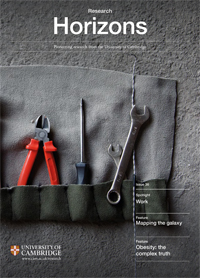
Researchers at the University of Cambridge are helping to understand the world of work – the good, the bad, the fair and the future. Here, Simon Deakin, Catherine Barnard and Brendan Burchell launch our month-long focus on some of these projects.
Researchers at the University of Cambridge are helping to understand the world of work – the good, the bad, the fair and the future. Here, Simon Deakin, Catherine Barnard and Brendan Burchell launch our month-long focus on some of these projects.
Researchers do not initiate projects simply to overturn conventional wisdom, but this is often what they end up doing, simply because few of the ideas or practices which are ‘taken for granted’ in everyday discourse can safely withstand this type of scrutiny.Simon Deakin, Catherine Barnard, Brendan Burchell
It’s an undeniable truth that getting ‘work’ right is as good for people as it is for the nation. Good work results in a healthy, fulfilled, safe and fairly paid workforce. It contributes to increasing productivity, better living standards and economic growth.
It’s also true that discussions of ‘work’ in politics and the media have often been highly charged. This is certainly the case today. Technological change, gender relations, Brexit and new models of working such as the gig economy are all factors that are changing the world of work.
Inevitably, in a University as large and diverse as Cambridge, there are multiple views on these issues and many approaches to researching them. While academics have been coming under increasing pressure for several decades now to disseminate their findings to policy makers and even to consider ways of monetising them for the benefit of companies, the first task of any researcher is how to frame a project in a way that will create new knowledge or understanding. Methodological innovation is the key to making an impact, initially in academia, and then more widely.
If there is a common theme uniting the different stands of Cambridge-based research on ‘work’, this is it.
For instance, a study of a unique historical archive is helping to tell us whether literacy rates or rules governing entry to trades were more important in determining economic growth in early modern Europe, an issue with relevance today to many developing countries.
In the context of the contemporary UK labour market, a randomised controlled trial of measures to facilitate job search will throw light on the complex interaction between unemployment and mental health.
The application of ‘big data’ analytics to a huge dataset of educational outcomes collected by a British government department is providing new insights on the relationship between educational attainment and inequality.
And clinicians and psychologists are plugging the gaps in workplace level data to get a better understanding of the link between precarious work and mental health outcomes.
Much of the research carried out in Cambridge is novel in the sense of being interdisciplinary. Geographers and economists are combining their efforts to get a better understanding of the ‘productivity gap’ between different regions of the UK, which is just as puzzling and persistent as the better known divergence between Britain and other industrialised countries. Economists and legal researchers have pooled their insights and resources to create a new method for coding different countries’ labour regulations, which should help resolve some long-standing questions concerning the effects of protective legislation on the economic performance of firms and nations.
Researchers do not initiate projects simply to overturn conventional wisdom, but this is often what they end up doing, simply because few of the ideas or practices which are ‘taken for granted’ in everyday discourse can safely withstand this type of scrutiny. One such idea is that governments can help promote economic growth by encouraging self-employment. Analysis based on face to face interviewing across several developed and developing countries suggests that the success of self-employment often depends on family ties, a factor neglected by policy makers.
Another piece of contemporary conventional wisdom is the claim that companies should invest in the emotional wellbeing of their employees to improve morale and performance. Analysis of one of the largest datasets of its kind suggests that chill-out zones and free yoga classes are less helpful in this regard than decentralising managerial decision making and organising work in such a way that employees build enduring relationships with colleagues and customers.
Among the issues at the forefront of public and media discussion today is that of gender equality. Research being carried out in Cambridge suggests that critical variables affecting women’s involvement in senior management positions across different countries include expected years of schooling for women, maternity laws, and the provisions of corporate governance codes setting requirements for gender diversity.
Other work shows that quotas for female directors are only part of the answer; organisations which encourage diversity at all levels rather than focusing solely on senior positions will have greater success in narrowing the gender pay gap and eliminating occupational segregation.
Another issue of pressing policy concern is Brexit. Research council funding has supported a major scheme of work, the UK in a Changing Europe programme, aimed at understanding the myriad different aspects of Brexit and its implications for British society and the economy. Cambridge-based researchers have played a central role in this programme and in disseminating its findings. On this topic, which has so sharply divided the nation, the contribution that social science can make to an informed debate is needed more than ever, but is more than ever in question.
Research has shown that beliefs about migrant workers exploiting the benefits system have little basis in reality, whereas there is evidence for migration causing undercutting of wages and pressure on public services in some regions of the country; these are findings that demand a wider public hearing.
When the issue of Brexit is finally resolved, we will still be left with the dilemmas posed by technological change, which are at least as old as the industrial revolution that transformed Britain at the start of the modern age.
Cambridge is a world leader in the science and engineering-based disciplines; perhaps less well known are the major investments recently made by the University in areas of the humanities and social sciences that address the risks and potential of technological advances. Philosophers and lawyers are helping us determine whether it makes any sense to assign legal personality to robots, business researchers are examining the impact of the algorithm on everything from the development of experts to the controlling of working practices, while economists are reminding us of the need to avoid crude characterisations of the threat to jobs from digitalisation.
Predicting the impact of technological change is inherently hazardous. Future readers of Research Horizons will know, as we cannot, who has been making the right calls.
Professor Simon Deakin (Centre for Business Research, Cambridge Judge Business School, and Faculty of Law), Professor Catherine Barnard (Faculty of Law) and Dr Brendan Burchell (Department of Sociology).
This article has been copied from http://www.cam.ac.uk by Hamza Ahmad Fagge
Friday, May 25, 2018
Thursday, May 24, 2018
Tuesday, May 22, 2018
Saturday, May 19, 2018
HUMAN & WOMEN RIGHT AND ISLAM
In
its Arabic texts, the Qur’an is considered the primary source of authority by
Muslims. The Qur’an is relatively a book of 77,000 words that are divided into
one hundred and fourteen chapters (Suras). A hundred and thirteen of the
chapters of the Qur’an begin with an indication of book’s intent (In the name
of Allah the All-Compassionate and the Ever-Merciful).
The
book is largely concerned with establishing boundaries that Muslims are
prohibited from transgressing. Within these boundaries the Qur’an treats human
beings as equally valuable and endowed with certain rights by virtue of simply
being human not taking one’s location, religion, ethnic origin, race, nation or
any other status into consideration, hence Human Rights. The rights bestowed
upon humans in the Qur’an include the right to life and peaceful living (as the
name of the religion implied Islam which means Peace), as well as
the right to own, protect and have property protected. The Qur’an also contains
rights for minority to the extent of dictating how Prisoners of war ought to be
treated.
In
the world of today, human right has been defined as; moral principles or norms
that describe certain standards of human behavior, and are regularly protect as
natural and legal rights in municipal and international law. They are commonly
understood as inalienable fundamental rights “to which a person is inherently
entitled simply because he or she is a human being”, and which are “inherent in
all human beings” regardless of their nation, location, language, religion,
ethnic origin or any status. They are applicable everywhere and at every time
in the sense of being universal, and they are egalitarian in the sense of being
the same for everyone.
They
are regarded as requiring empathy and the rule of law and imposing an
obligation on persons to respect the human rights of others, and it is
generally considered that they should not be taken away except as a result of
due process based on specific circumstances, for example, human rights may include
freedom from unlawful imprisonment, torture and execution.
EQUALITY
IN ISLAMIC HUMAN RIGHT
The
Qur’an states that all human are the descendants of one man Adam and are
therefore brother to one another. The emphases on equality and justice in the
Qur’an appear throughout the text and include one’s enemy. The duty of Muslims
to be just and truthful enjoys a high priority status, in the Qur’an, and is
described in the following manner, that
“O
you who believe! Be maintainers o justice, bearers of witness of Allah’s sake,
though it may be against your own selves’ or (your) parents’ or near relatives;
if he be rich or poor, Allah is nearer to them both in compasson; therefore do
not follow (your) low desires, lest you deviate; and if swerve or turn aside,
then surely Allah is aware of what you do”. The Qur’an also unequivocally restricts
its believers from aiding someone in need of their help only where they intend
to deceive or carry out an act of aggression by stating “help one another in
goodness and piety, and do not help one another in sin and aggression”.
Furthermore, the Qur’an teaches its followers that treating followers of other
religions justly and kindly is an article of faith.
RIGHT
OF MINORITIES AND OTHER RELIGIOUS GROUPS IN ISLAMIC LAW
Although
the Qur’an is the religious scripture of Islam, it prohibits Muslims from using
any method of compulsion to influence the religious practices, and beliefs. The
Qur’an goes even further in protecting the rights of the followers of other
faiths by obligating Muslims to protect al “cloisters and churches and
synagogues and mosques in which God’s name is remembered”. In relation to
different ethnic, cultural and religious groups the Qur’an tell Muslims “for
every one of you did We appoint a law and a way, and if Allah had pleased He
would have made you (all) a single people, but that He might try you in what He
gave you, therefore strive with one another to hasten to virtuous deeds”.
The Qur’an advocates equality between all and says that the only good deeds may
raise the status of one human over another.
WOMEN’S
RIGHTS IN ISLAM
If
the world will be just and fair to women, it shall ask them to abide by the
Islamic laws upon them despite their religion belief, race or nation. It is
known to every human of history that, before the emergence of the religion of
Islam; women are being buried and killed alive for they are not loved by the
then men (their male-parent), this is because they were regarding them as
liability to their lives and weak in other ways, but Islam came and freed women
from all tortures and covered them physically, mentally and spiritually.
With
regards to women’s right, the Qur’an dedicates one whole chapter of its
one-hundred and fourteen chapters to women which is evident from the very name
of the chapter, Women (An-Nisa). The Qur’an in that chapter states that whoever
does good deed, whether they are male or female, shall enter Paradise and not
the least bit of injustice shall be dealt to them. The same message is repeated
in chapter sixteen “Whoever does good whether male or female and he is a
believer, We will most certainly make live a happy life, and We will most
certainly give them their reward of the best of what they did”. The ability
of women to bear children is a significant attribute used by the Qur’an in a
number of verses to uplift the status of women. One such chapter state “And
give women their dowries as a free gift, but if they of themselves be pleased
to give up to you a portion of it, then eat it with enjoyment and with
wholesome result”.
Women
have also being given the right to inherit in the Qur’an. The Qur’an in one
particular verse creates an additional obligation on men to provide, protect
and generally take care of women as their guardians and not as superiors. Perhaps
the most valued status, with regards to women, is that of a mother in the
Qur’an as it illustrates this point by binding the reward of paradise to those
who satisfy the needs of their parents.
In
conclusion
women have the best and gained the highest right in Islam beyond every other
service. They were asked to cover their bodies so as to avoid increase in
fornication and rape (the number one problem in the world today), but we are
cultivating the result of women nakedness (which became sort of fashion and
style) in our lives today, which if the women of the world would only accept
the law given by Islam to covering up their bodies and avoid nakedness, we will
in a year solve 90% of the global rape cases.
TRY
IT AND SEE!
H.A
Fagge
#thewinnershub
Friday, May 18, 2018
HOK Sustainable Designs
With us, your Architectural Design problems are solve.
Just contact us at http://www.hok.com


Reaching your needs is our priority
Thursday, May 17, 2018
FEMALE ENTREPRENEURS
Make your desire of success greater than your fear of failure
(For female entrepreneurs (most especially in Nigeria))
Entrepreneurship has traditionally been defined as the process of designing, launching and running a new business, which typically begins as a small business, such as a startup company, offering a product, process or service for sale or hire. It has been defined as the “Capacity and willingness to develop, organize and manage a business venture along with any of its risks in order to make a profit.
An entrepreneur is typically in control of a commercial undertaking, directing the factors of production – the human, financial and material resources – that are required to exploit business opportunity.
They act as the manager and oversee the launch and growth of an enterprise.
Women became more involved in the business world only when the idea of women in business became palatable to the general public.
Before the 20th century, female operated small businesses as a way of supplementing their income. In many cases, they were trying to avoid poverty or were replacing the income from loss of a spouse. At that time, the ventures that these women undertook were not thought of as entrepreneurial. Many of them had to focus on their domestic responsibilities. The term entrepreneur is used to describe individuals who have ideas for products and/or services that they turn into a working business. In earlier times, this term was reserved for men.
Home-based businesses helped to solve a good part of most problems for those women who worried about being mothers. One Lillian Vernon, while pregnant with her first child, started her own business dealing with catalogs by investing money from wedding gifts and started filling orders right at her kitchen table. Mary Crowley founded Home Decorating and Interiors as a way of helping women to work from home by throwing parties to sell the products right in the comfort of their own home. In an effort to avoid criticism and lost business from those who did not support women in business, Bette Nesmith, who developed the product “Mistake Out,” a liquid that painted over mistakes in typing, would sign her order B. Smith so no one would know she was a female.
Studies have shown that successful female entrepreneurs start their businesses as a second or third profession. Because of their previous careers, female entrepreneurs enter the business world later on in life, around 40-60 years old. According to the Global Entrepreneurship Monitor report, “women are nearly one-third more likely to start business out of necessity than men.” Because women are overtaking their male peers in the level of education obtained, the average self-employment rate for women under 25 years old in OECD countries is 7.2%.
"In the grab for power, women use whatever means available to them, whereas a man would take a club to his opponents head, a woman is more likely use other less forceful and more subversive measures. Let's just own it, we have different weapons in our arsenal." Female entrepreneurs make up for approximately 1/3 of all entrepreneurs globally. According to one study, in 2012 there was an approximate 126 million women that were either starting or already running new businesses in various economies all over the world. As far as those who were already established, there was an approximate 98 million. Not only are these women running or starting their own businesses but they are also employing others, so that they are participating in the growth of their respective economies.
A study in India entitled "Barriers of Women Entrepreneurs: A Study in Bangalore Urban District", has concluded that despite all these constraints, successful female entrepreneurs do exist. Female entrepreneurs have evidently more to ‘acquire’ than their male counterparts. But, the socio-cultural environment in which women are born and raised hinders them. Social customs, caste restrictions, culture restraints, and norms leave women lagging behind men.
PRESENT CHALLENGES ON BEING A FEMALE ENTREPRENEUR
Even though female entrepreneurship and the formation of female-owned business networks is steadily rising, there are a number of challenges and obstacles that female entrepreneurs face. One major challenge that many female entrepreneurs face is the effect that the traditional gender-roles society may still have on women. Entrepreneurship is still considered as a male-dominated field, and it may be difficult to surpass these conventional views. Other than dealing with the dominant stereotype, female entrepreneurs are facing several obstacles related to their businesses.
Obstacles specific to starting new firms
External finance and sex discrimination.
In general, women have lower personal financial assets than men. This means that for a given opportunity and equally capable individual, women must secure additional resources compared to men in order to exploit the opportunity; because, they control less capital. The question of whether women have a harder time getting finance than men for the same business opportunity has developed into its own sub-field. One possible issue in raising outside capital is that 96% of senior venture capitalists are men and may not be as understanding of female-centric businesses. However, the situation seems to be improving.
A study by Babson College showed that in 1999, fewer than 5% of venture capital investments went to companies with a woman on the executive team. In 2011, it was 9% and in 2013 it had jumped to 18%.
A specific solution for solving women's difficulties for obtaining financing has been micro-financing. Microfinance is a financial institution that has become exceptionally popular, especially in developing economies. Female entrepreneurs have also been especially successful in getting funded through crowdfunding platforms like Kickstarter.
Obstacles to managing a small firm
Studies on female entrepreneurs show that women have to cope with stereotypical attitudes towards them on a daily basis. Business relations—from customers to suppliers and banks—constantly remind the entrepreneur that she is different, sometimes in a positive way such as by praising her for being a successful entrepreneur even though she is a woman. Employees tend to mix the perceptions of the manager with their images of female role models, leading to mixed expectations on a female manager to be a manager as well as a "mother".
The workload associated with being a small business manager is also not easily combined with taking care of children and a family. However, even if the revenues are somewhat smaller, female entrepreneurs feel more in control and happier with their situation than if they worked as an employee. Female entrepreneurship has been recognized as an important source of economic growth. Female entrepreneurs create new jobs for themselves and others and also provide society with different solutions to management, organisation, and business problems. However, they still represent a minority of all entrepreneurs. Female entrepreneurs often face gender-based barriers to starting and growing their businesses, like discriminatory property; matrimonial and inheritance laws, and/or cultural practices; lack of access to formal finance mechanisms; limited mobility and access to information and networks, etc.
A woman's entrepreneurship can make a particularly strong contribution to the economic well-being of the family and communities, poverty reduction and women's empowerment, thus contributing to the Millennium Development Goals (MDGs).
Thus, governments across the world, as well as various developmental organizations, are actively undertaking the promotion of female entrepreneurs through various schemes, incentives and promotional measures. Female entrepreneurs in the four southern states and Maharashtra account for over 50% of all women-led small-scale industrial units in India
Obstacles to growing firms
A specific problem of female entrepreneurs seems to be their inability to achieve growth, especially sales growth. Another issue is finance and, as stated previously, the entrepreneurial process is somewhat dependent on initial conditions. In other words, as women often have a difficult time assembling external resources, they start as less ambitious firms that can be financed to a greater degree by their own available resources. This also has consequences for the future growth of the firm.
Basically, firms with more resources at start-up have a higher probability to grow than firms with fewer resources. Resources include the following: societal position, human resources, and financial resources. This initial endowment in the firm is of great importance for firm survival and especially for firm growth.
A study by the Kauffman Foundation of 570 high-tech firms started in 2004 showed that women-owned firms were more likely to be organized as sole proprietorships, both during their startup year and in the years to follow. Female entrepreneurs were also much more likely to start their firms out of their homes and were less likely to have employees. This fact may serve as an indication that women either anticipated having smaller firms or were operating under resource constraints that did not allow them to launch firms requiring more assets, employees, or financial resources. This study also found that women only raised 70% of the amount that men raised to start their firms, which ultimately impacted their ability to introduce new products and services or expand their business in terms of employees or geographic locations.
Other problems that are facing female entrepreneurs is how they are handling their decision-making models and stressful situations. Women compared with men are more susceptible to be influenced by their feelings than men when they have to make decisions. Also women have more likelihood of stress than men in difficult situations, without this mean that women are "weak sex".
Despite the fact that many female entrepreneurs face growth barriers, they are still able to achieve substantial firm growth. There are examples of these both in a number of developing economies (Ethiopia, Tanzania, and Zambia) surveyed by the ILO, as well as in more developed economies such as the United States.
REASONS FOR STARTING A FIRM BY A WOMAN
Many studies show that women start their own businesses for a variety of reasons. These reasons include the following: having an idea for a business plan, having passion for solving a specifically related career problem, wanting to be more in control of their careers, maintaining a more balanced life, having a flexible work schedule, and taking a personal vision and turning it into a lucrative business. Along with the intense desire to see their vision carried out, these women also have a great ability to multi-task and never feared the risks involved in being self-employed. Women are still facing many issues in the workforce, and being their own boss certainly is more appealing to some of the everyday issues they face outside of entrepreneurship. Gender roles are still very much a part of their lives, but for some female entrepreneurs, they feel more in control when working for themselves.
No matter what your reason is, the time to becoming an entrepreneur is now!
ENCOURAGEMENT
In 1993, "Take Our Daughters To Work Day" was popularized to support career exploration for girls, and later expanded to Take Our Daughters and Sons to Work Day. Hillary Clinton stated that "Investing in women is not only the right thing to do, but also the smart thing to do." Research shows that there are many support groups for women in business, for female entrepreneurs, and for women looking for business advice. Women in different areas are willing to show the support that in some cases, they never had. They offer encouragement, advice, and support to moms who seek to provide for their families through their own visions for business. HerCorner, is a group located in Washington, D.C. This groups seeks to bring women business owners together to collaborate with each other for the betterment of their businesses. There are government backed programs available to female entrepreneurs and information can be found on their website at SBA Online and their Facebook group SBAgov. Female-only taxi companies in India, the UAE, and Brazil support working women. One example of successful female entrepreneurship in rural villages of Bangladesh is the Infolady Social Entrepreneurship Programme (ISEP). Norway celebrates Female Entrepreneur of the Year.
When will I hear from your firm?
Why Not Start Your Firm Today? YES! You can do it, just by making your desire of success greater than your fear of failure.
Hamza Ahmad Fagge
From
#thewinnershub2018
Subscribe to:
Comments (Atom)